You earned the rebates. Now collect them.
Rebate Recovery, formerly HART
Supplier rebate tracking, management and recovery software for health systems. It holds every rebate agreement as it is written, checks it against what you actually bought, and turns the difference into a short list of money to collect and money still to win.
The contract page on this screen is how the assistant reads an agreement: every value with its evidence, the one it could not find boxed in red, and the read-back underneath.
Rebate agreement, schedule B
Volume tiers and payment terms
| Tier | Annual purchases | Rebate |
|---|---|---|
| 1 | Up to $1,500,000 | 2.0% |
| 2 | $1,500,001 to $3,000,000reached in Q2 on $2.1M of purchases | 3.5% |
| 3 | Over $3,000,000 | 5.0% |
- Rebates are paid quarterly, within 45 days of the period end.Found word for word, page 4
- Buyer maintains 65% market share of the category.Close match, page 7: written as “sixty-five percent (65%) of annual category spend”
- Tier 3 rate.No quote found. Creation is blocked until a named person confirms the rate
Read-back3.5% on every purchase once annual spend passes $1,500,000, retroactive to the first dollar, paid quarterly within 45 days of each quarter end.
Three figures, never added together
A single “total at stake” is how rebate reports mislead. Money that is owed, money that is pacing and money that is possible need different work, so they stay apart.
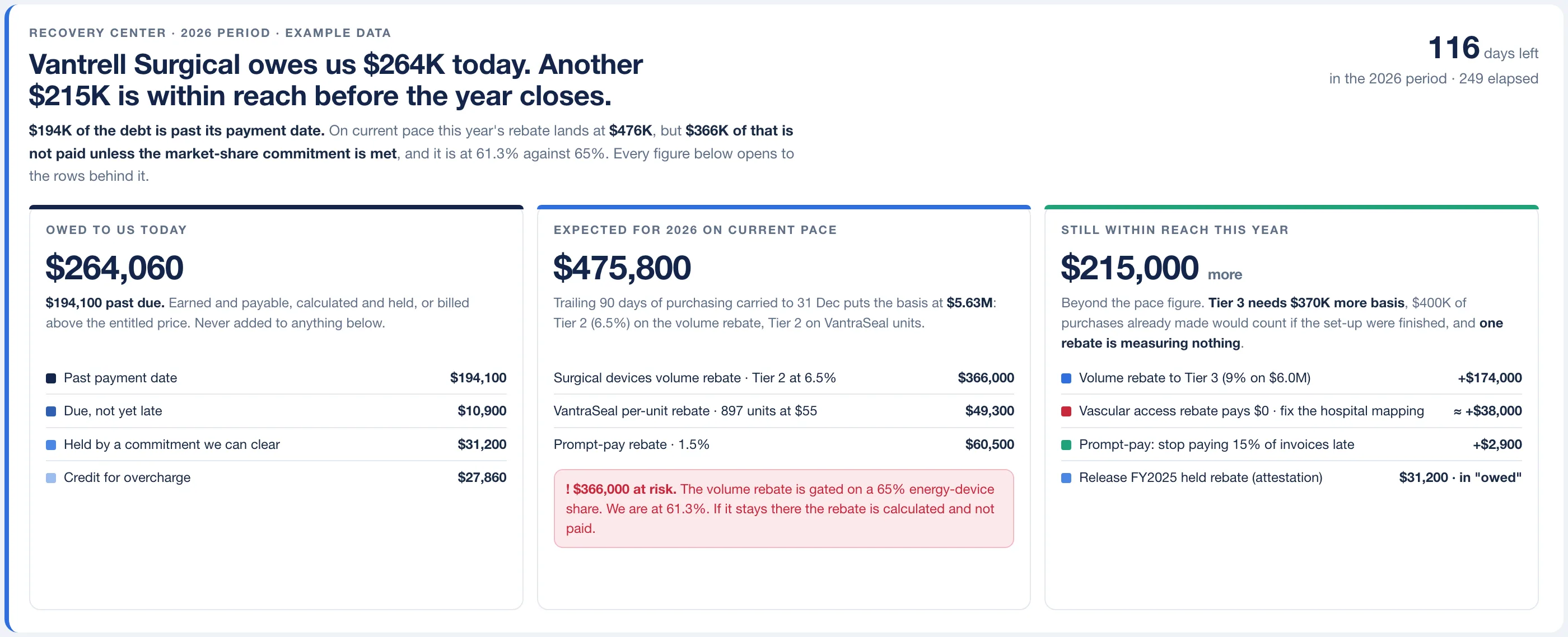
- 1Owed today, split by the reason each dollar is owed: past due, due, held, overcharged.
- 2The part of this year’s pace that is not paid unless the share commitment is met.
- 3What the next tier is worth, and the purchases it would take to reach it.
- Owed to you today
- Earned and past its payment date, due but not yet late, held by a commitment you can still clear, or billed above the price you were entitled to. Split by reason, because each is collected differently.
- Expected this period, on current pace
- Where the purchasing pace so far lands you by period end, rebate by rebate, with the part at risk behind an unmet commitment called out. Pace arithmetic, labelled as such, not a prediction.
- Still open before the period closes
- What the next band is worth and how much more purchasing it takes, where that volume can come from, and which rebates are paying nothing because the set-up is unfinished.
Work out the three figures for one of your own contractsAll the rebate worksheets
It starts with the contract as written
Upload the signed agreement. The contract assistant reads it page by page and proposes the programs, tiers, commitments, facilities, dates and caps as an editable draft. Every value carries its evidence: found word for word on a cited page, a close match, or not found.
A rate or a dollar amount with no quote behind it blocks creation until a named person confirms it. The assistant asks what kind of document it has been given, and turns away amendments, excerpts and price files with a reason rather than guessing at them. What comes out is always an inactive draft, and a person presses Create.
Then each term reads itself back in one sentence, so the check is one sentence against one clause.
- Found word for wordTier 2 rate3.5% of net purchasesQuoted from the agreement, page 12, and matched exactly.
- Close matchMeasurement periodCalendar quarterPage 4 says “each quarter of the Agreement Year”. A person confirms which quarters.
- Not foundAnnual cap$250,000No sentence in the document supports this figure. Creation is blocked until a named person confirms it.
Illustrative clause and figures. The draft is always inactive until a person presses Create.
The contract shapes that actually show up
One word in a clause can be a fourfold difference in the check. The engine models the agreement as written instead of the nearest thing a spreadsheet can hold.
- Tiered spend and volume rebates: flat, retrospective to the first dollar, or stepped
- Percent, per-unit and fixed-amount rates
- Growth over a baseline: prior year, prior period or a fixed figure
- Year-to-date cumulative tiers with the retroactive uplift paid automatically
- Market share ladders, on share of spend or share of units
- Per-product rate tables
- Prompt-pay discounts, invoice by invoice
- GPO and distributor admin fees, accrued from your purchases and checked against the statement
- Distributor sales tracing programs
- Annual true-up against a second ladder, with no clawback
- Caps, floors and carry-forward
- Per-facility terms that do not aggregate
- Per-procedure rebates from surgical usage
- Outcome programs, where a person records the qualifying event
- Commitments that gate a rebate: any two of three, either-or targets, ratchets by agreement year
- Pro-ration of targets for partial periods
Hundreds of findings, a handful of decisions
A scheduled rules pass raises 29 kinds of alert, from an overdue payment to a market share that is measuring no market. Every actionable dollar is sorted into a lane by the kind of work it needs and the queue is ranked by money. Findings are grouped by cause, because one cause has one remedy.
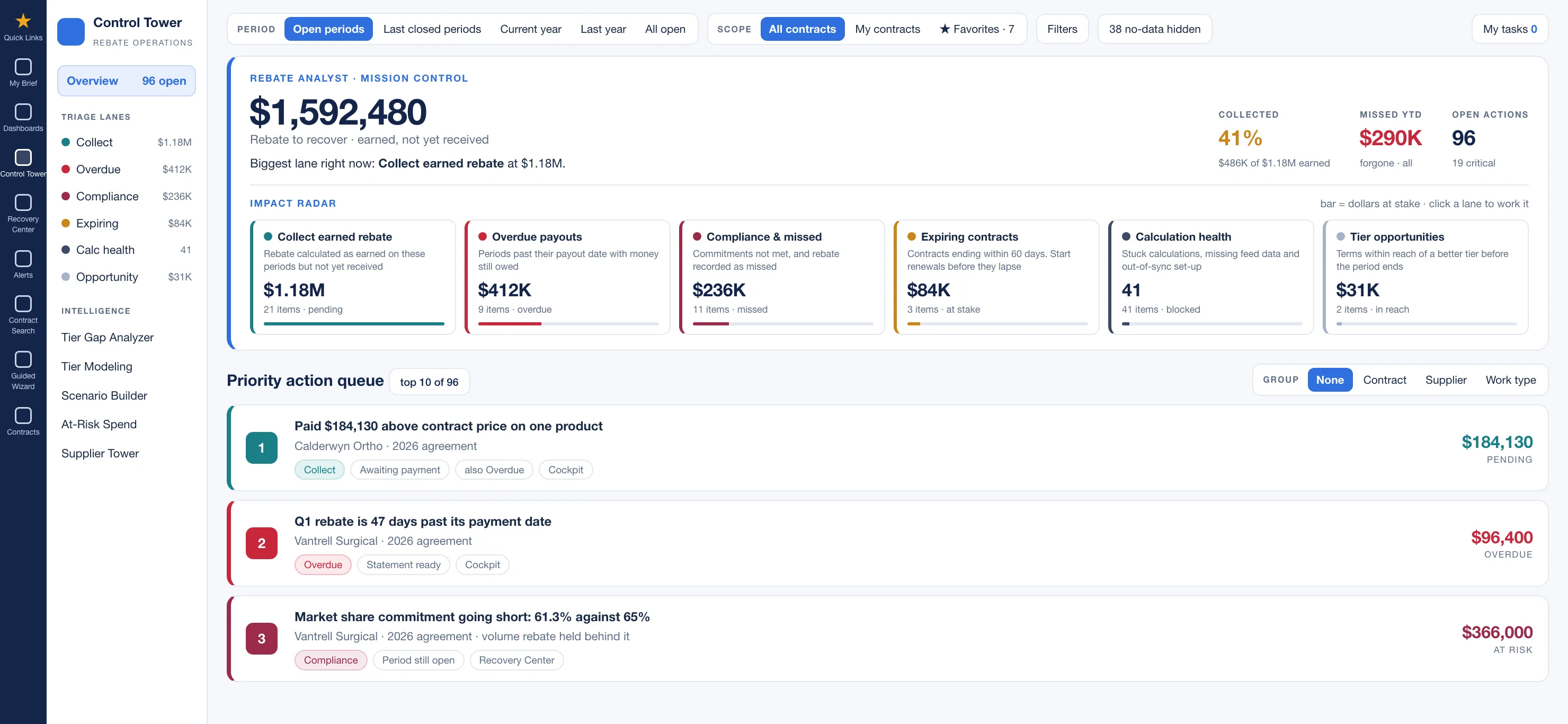
- 1Every actionable dollar in a lane by the kind of work it needs: collect, chase, comply, renew, fix.
- 2The queue, ranked by money, with the reason and the contract on each line.
The questions a CFO asks, answered on one screen each
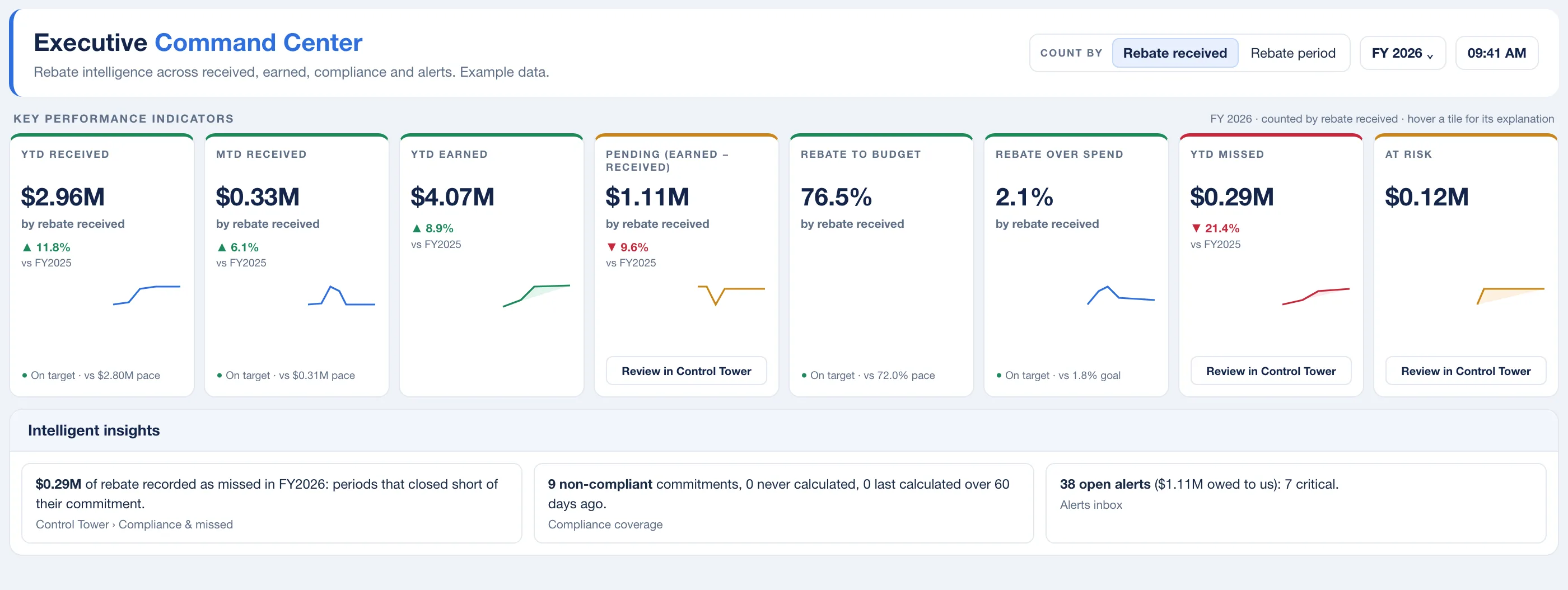
How is the rebate year going?
Received, earned and pending for the year, rebate against budget, what was missed and what is at risk, each with its trend against last year and a pace line.
Every tile opens to its definition, its formula and the source it reads. A data source that fails shows blank with a banner rather than a confident zero, so a leadership meeting never runs on a number nobody can explain.
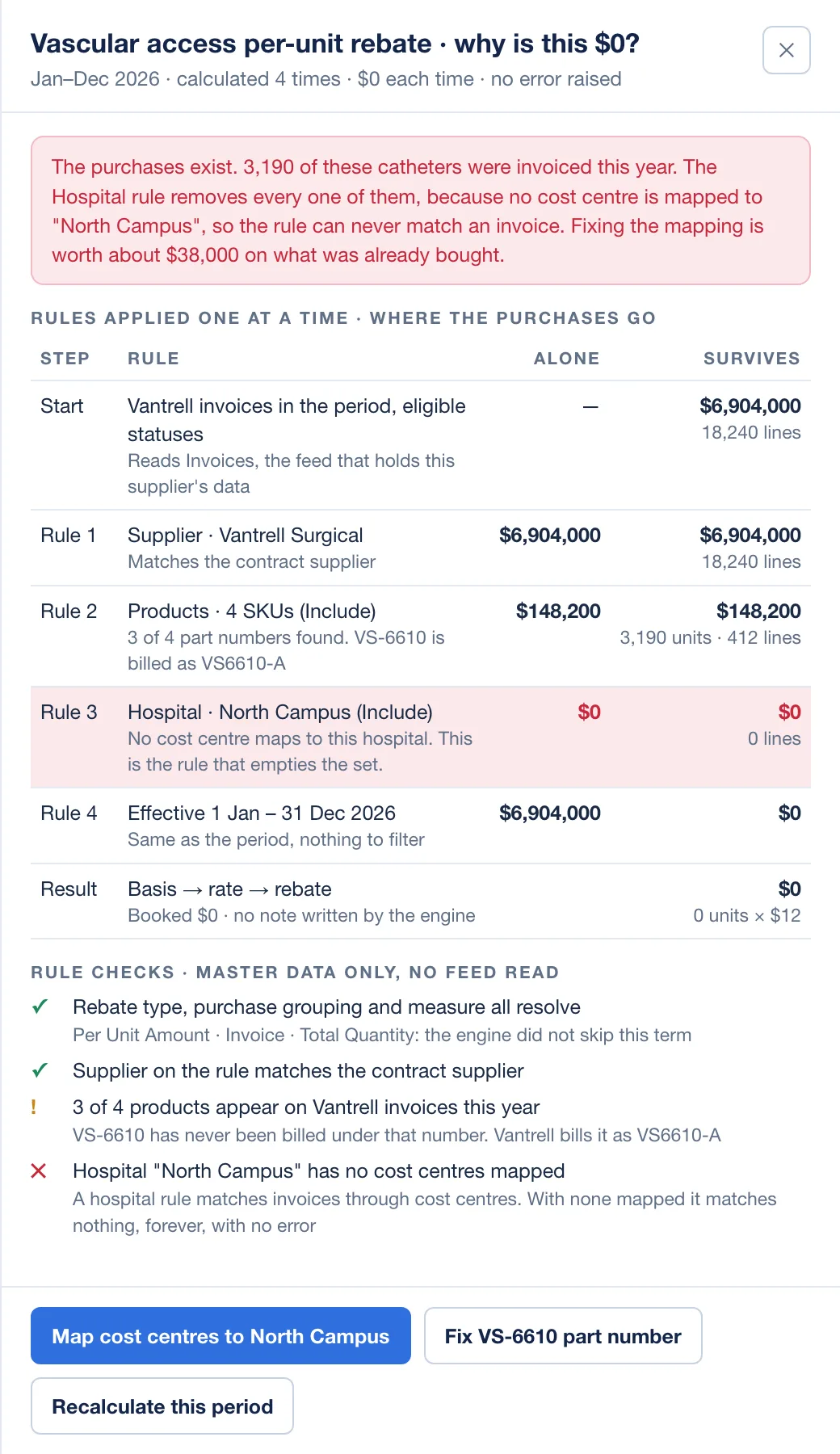
Why does this rebate read $0?
The most expensive rebate problem is silent. A product tag that no item carries. A hospital with no cost center mapped to it. A unit ladder counting a box of twenty as one. The calculation runs, returns zero, and nobody is told.
So every result explains itself, including every zero. Ask why a rebate is zero and each rule is applied in turn until you see the one that empties it, and what fixing it is worth on purchases already made. When a fact is missing, the engine never widens the scope to make the math work: a visible zero is fixable, and money booked on a guess is found by the supplier.
Are we meeting the market share commitment?
A share measured only against the supplier’s own products reads 100% forever, and every rebate behind it pays unconditionally. Scoped one level too wide, an 85% commitment reads under 1% and can never pass.
Each share commitment states its own market: a product class, a spend category, or a curated list matched on part number. The same definition is applied to the top and the bottom of the fraction, and two alerts stand guard: one for a market that is empty, one for a market that is far too wide.

How a rollout goes
Start with a handful of contracts that matter. The first useful statement does not wait for the whole portfolio.
Load your purchase data
Invoices, purchase orders, receipts, distributor sales tracing, surgical usage, item and supplier masters. Files are validated before anything loads, with a verdict in words: what will load, what will be skipped, and why.
Bring in the contracts
Upload the signed PDF and review the draft the contract assistant proposes, or build the contract in the guided wizard. Either way a named person approves before anything is created.
Check the read-back
Every term reads itself back in one sentence. You compare that sentence with the clause, not a screen of fields with a spreadsheet.
Let the engine run
Each rebate and period books as earned, lost or still open, with a written reason. It re-runs as new purchase data lands.
Work the lanes
Fix what makes numbers untrustworthy first. Then overdue money, money to collect, commitments going short, and tiers you can still reach while the period is open.
Reconcile what arrives
Record each supplier payment, accept or adjust the proposed split across periods, and send a statement with invoice-level evidence where the remittance disagrees.
Who works in it
- Contract and rebate analysts
Start the day with a short list ranked by dollars. Reconcile payments, produce supplier statements, and answer “why is this zero” without querying a database.
- Sourcing and contracting leaders
See a commitment going short while it can still be fixed, and what the rebate hanging on it is worth.
- Finance and accounting
Earned, received and pending by contract, supplier, company, cost center and hospital, exported for month end and tied to the same results every other screen shows.
- Supply chain executives
The rebate year on one page: how the portfolio is pacing against budget, what was missed, what is at risk, with every tile explaining its own formula.
- Suppliers
A scoped dashboard of their own contracts, and a rule-by-rule interpretation packet they can confirm or dispute. Agreement on the math before the money is due.
Questions buyers ask
Straight answers, including the ones that are “no”.
How does our purchase data get in? Do we need an ERP integration?
No integration project. Data arrives as files: CSV or Excel uploads through the data loader, or a scheduled secure file drop from your ERP. Fourteen file types are supported, and every file is validated before it loads. The product does not connect to your ERP in real time, and it does not need to.
What does the AI do, and what does it not do?
It reads a signed agreement into a draft contract, and it answers questions about your numbers. Every value it extracts shows whether the wording was found word for word on a cited page, was a close match, or was not found. A rate or amount with no quote behind it blocks creation until a named person confirms it. The result is always an inactive draft. The assistant that answers questions is read-only, takes every figure from a system query rather than from the model, and every exchange is logged. Alerts and calculations are rules and arithmetic, not AI.
Does it forecast our rebates?
It shows where current pace lands by period end and what a change in purchasing would do to tier and share together. That is arithmetic on your own data, and the screen says so. It does not predict.
How current are the numbers?
Screens show the last calculation run and say when that was. Rollups refresh about every fifteen minutes in business hours, alert detection runs on a schedule, and anyone with access can recalculate a contract on demand.
Does it chase suppliers or file claims for us?
No. It produces the evidence: a statement to the supplier by reason and period, invoice-level exports for overcharges, and a rule-by-rule interpretation packet. People send them. Alerts appear in the product, not by email.
We use GPO contracts, local contracts and distributor agreements. Does it handle all three?
Yes. Contracts carry their source, reports split received rebate by GPO, local and distributor agreements, and admin fees are accrued from your own purchases and compared with the statement you are sent.
Does every user see every screen?
Access is by role, and users can be limited to specific hospitals or suppliers. The newest workspaces, the recovery page and the alert lanes, are released to administrators first and widened as they settle. Ask us which are generally available when you talk to us.
We already had a recovery audit. Do we still need this?
They look at different years. An audit looks back at closed years; this checks the open period while a missed tier can still be reached. The two can work together: an audit for the years before go-live, software from then on.
We already use an exchange or price-sync service. Where does this fit?
After it. A price accuracy service checks that each invoice carries the contract price. This checks what the contract still owes once those invoices are paid: rebates earned against rebates received, tiers and commitments, and admin fees. The two do different jobs, and clean invoice prices make the rebate arithmetic easier to defend.
What does it not cover?
Chargebacks, payer-side revenue cycle work, and clinical outcome detection are outside it. Fiscal calendars are calendar-year today. If your agreements depend on something unusual, bring one to the demo and we will tell you straight whether it fits.
Better with clean implant spend
The largest rebate contracts sit on physician preference items, and much of that spend arrives as bill-only. Implant Control makes it clean at the source: contract price, the right catalog number, tied to a real case.
Further reading on rebates
AI contract abstraction for healthcare supplier agreements: where it fails, how to review
What AI extraction gets right in supplier rebate agreements, where it predictably misses, and a review protocol that ends with a back-test against a period you were already paid for.
Building the CFO business case for rebate and implant spend controls
A vendor-neutral method for sizing rebate and bill-only implant opportunity from your own ledger, contracts and a small sample, then presenting it in terms finance can verify.
GPO rebates vs. local contract rebates: what to track separately and why
Supplier rebates on GPO contracts, GPO fee share-backs and local agreement rebates are three separate receivables. How each works, how to verify it and how it reaches the cost report.
The data you need before you can trust a rebate or price calculation
Rebate and contract price calculations fail at the join, not the math. Four data conditions to get right, and eight monthly tests that show whether your numbers can be trusted.
Bring one contract. Leave with the statement.
Pick a supplier agreement that matters and a purchase extract. In a working session we load it, run it, and show you what it has earned, what has been received and what is still open.