Collect what you earned. Pay what you agreed.

Supplier contracts promise your hospital money back and prices held. Techinquest software checks both against what you actually bought, line by line, and hands you the statement.

Healthcare rebate tracking and bill-only implant control for hospital supply chain and finance teams. Built in Frisco, Texas.

Statement of account

Rebates earned, not yet received

Fiscal year to date. Supplier and figures are illustrative.

Contract lineSupplier paidContract saysOwed to you
Cardiac rhythm devicesTier 3 reached in Q2, remitted at the tier 2 rate428,000612,000(184,000)
Orthopedic implantsQ1 rebate is 47 days past due096,400(96,400)
IV solutionsShare commitment met, rebate never claimed0212,750(212,750)
Owed to you today$493,150

+$103,000still winnable: Exam gloves are $840K of spend from the next tier, with 61 days left in the period.

Two places the money goes missing

Both still run on spreadsheets, email and paper in many health systems. Both are contract money, already negotiated, that never reaches the bottom line.

Rebates you earned and never collected

A tier is reached and paid at the old rate. A payment is 47 days late and nobody is counting. A market share commitment is met but the form was never filed, so the rebate is forfeited. None of it raises an error. It just does not arrive.
Rebate Recovery

Implants billed above contract

Bill-only implants arrive with the vendor rep, and the purchase order is written after the surgery, from a sticker sheet. The price is whatever was typed. By the time anyone compares it with the contract, the invoice is paid.

Implant Control

One is control at the point of spend, the other is collection after it. The implant spend that Implant Control cleans up is exactly where the largest rebate contracts live, so Rebate Recovery has clean purchases to claim against. Neither replaces your ERP.

Rebate Recovery

The money your suppliers still owe you, worked out from your own purchases: owed today, on pace this period, and still open before the period closes. Three figures, never added into one.

  • You see the shortfall before the supplier’s statement arrives

    Each period is calculated from your purchases at the tier they actually reached. A payment at a lower tier leaves the difference open on the contract’s page.

  • Every number shows its work, including every $0

    Each result carries a sentence saying what matched, what did not and what would close the gap. A rebate reading zero names the rule that emptied it.

  • Contracts as they are written

    Retrospective and stepped tiers, growth over baseline, market share ladders, true-ups, caps, prompt pay, admin fees, per-facility terms.

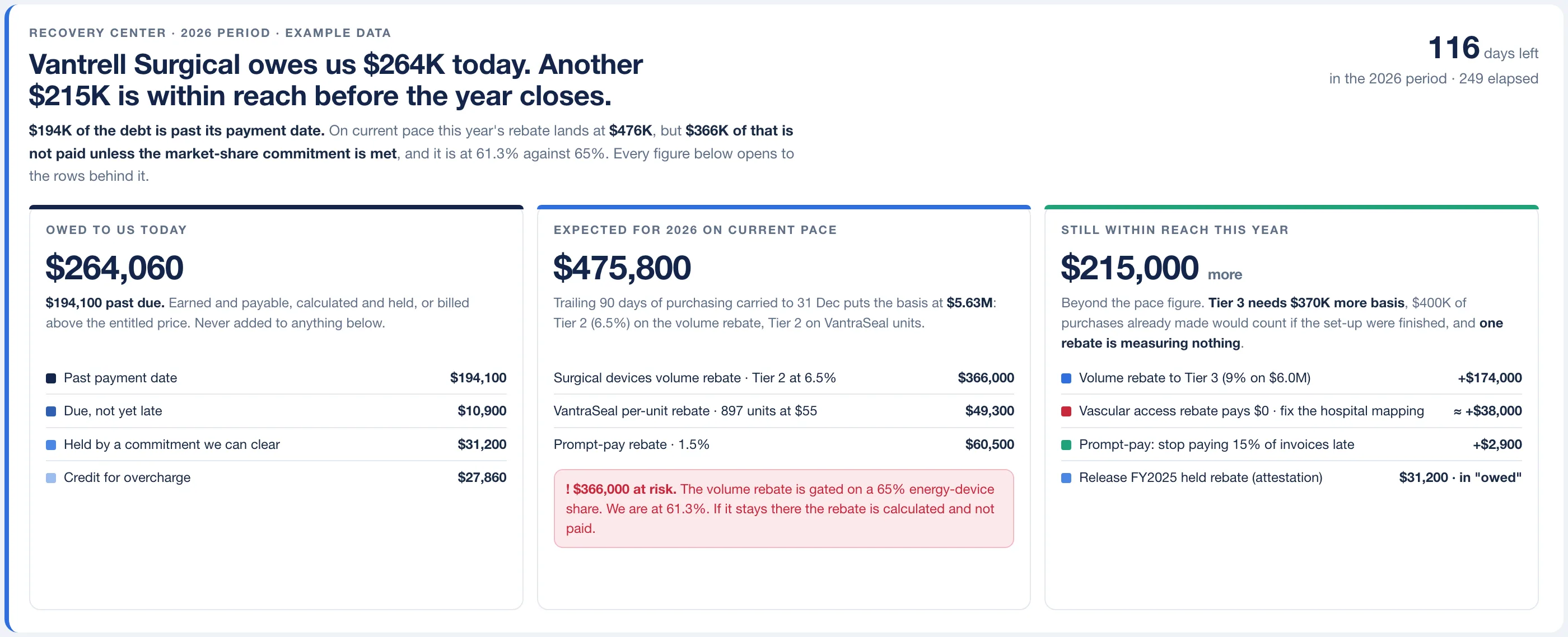
Recovery Center for one supplier contract. Three separate figures: $264,060 owed today, split by reason; $475,800 expected this year on current pace, with $366,000 at risk behind a market share commitment at 61.3% against 65%; and $215,000 more still within reach.
  1. 1Owed today, split by the reason each dollar is owed: past due, due, held, overcharged.
  2. 2The part of this year’s pace that is not paid unless the share commitment is met.
  3. 3What the next tier is worth, and the purchases it would take to reach it.
What are we owed today, and what is still within reach?Recovery Center: owed today, expected on current pace, and still within reach, never added together. Released to administrators first. Every name and figure is invented.
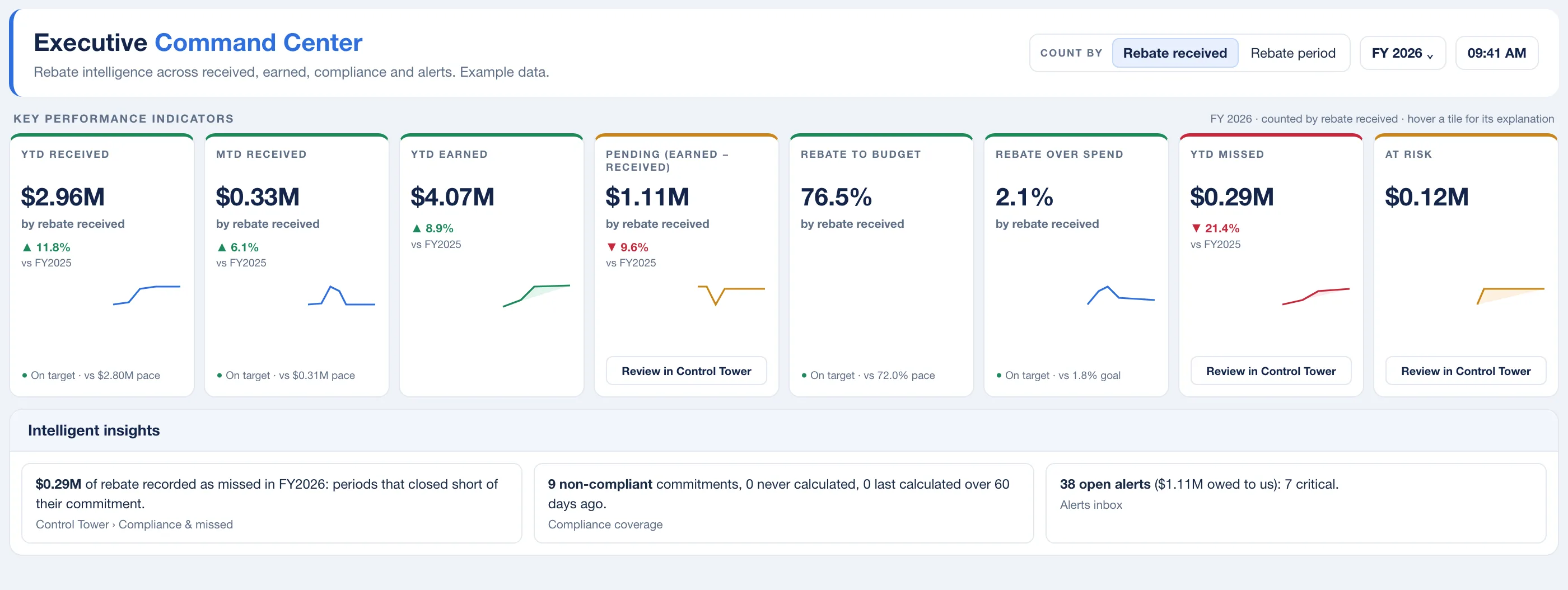
Executive Command Center. Eight KPI tiles: year-to-date received, month-to-date received, year-to-date earned, pending, rebate to budget, rebate over spend, missed and at risk, each with a change against last year, a sparkline and an on-target flag. Below, three insight cards on missed rebate, non-compliant commitments and open alerts.
A contract, from signed PDF to statementOne supplier contract loaded, calculated and read back, then the rebate year on one page. Figures illustrative.

Implant Control

The vendor rep files the bill-only request once, online. Every line is checked against your contract price and the surgical case before a purchase order exists. Your team works only the lines that differ.

  • The price you negotiated is the price on the request

    Lines are picked from your contract price list at your price. Anything off contract is entered separately and flagged before approval, not found in an audit a quarter later.

  • Did we implant what we were billed for?

    Every request is matched to the surgical case on catalog number, quantity and price. Quantity one request has claimed is not available to the next.

  • Your bill-only policy, enforced on every submission

    Late needs a written reason, too late is refused, a duplicate case number is flagged. The software holds the line so reminder emails do not have to.

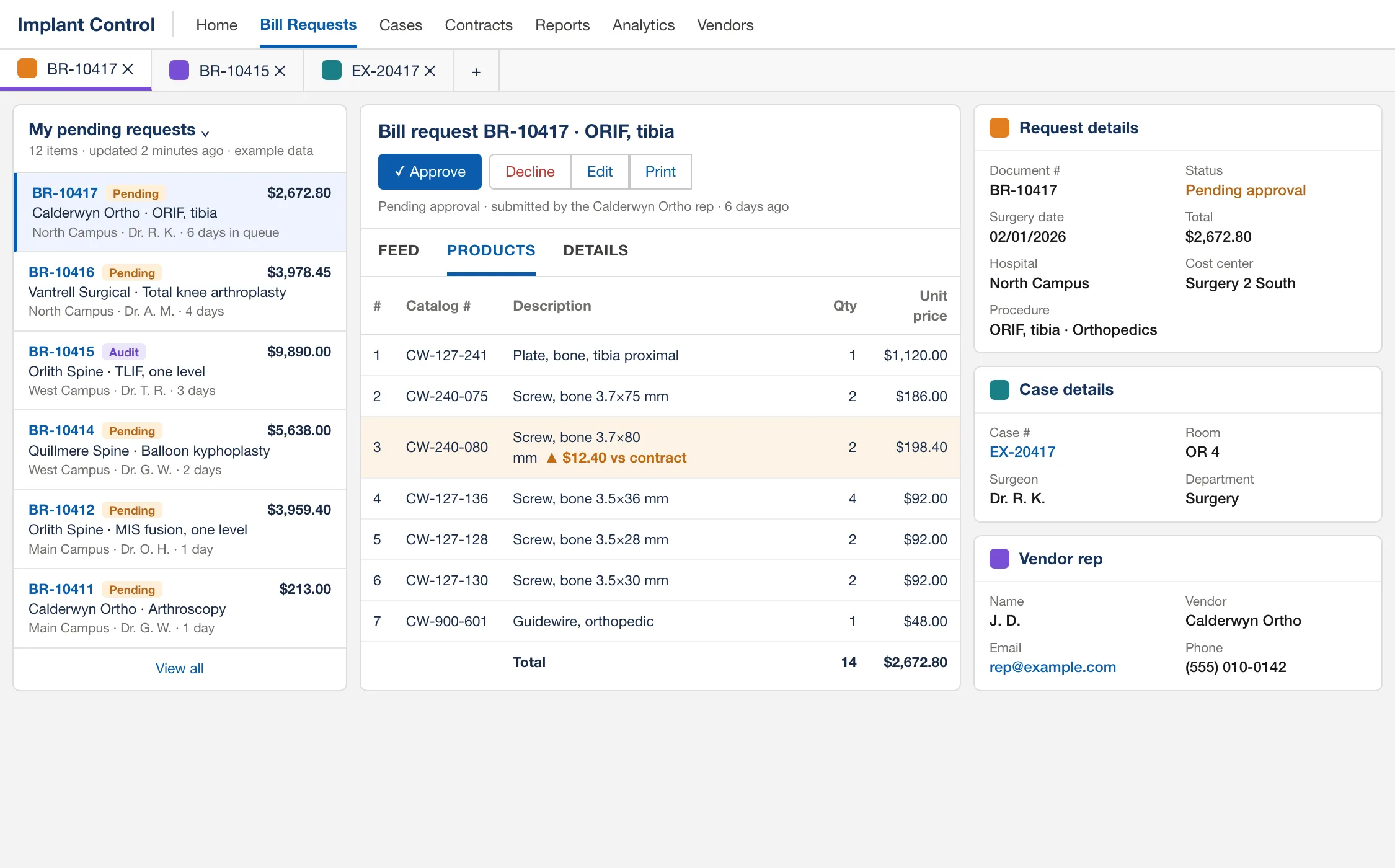
Approver console. A queue of pending bill-only requests on the left; the open request lists seven implant lines, and line 3 is flagged as $12.40 above contract price. Request, case and vendor rep details sit beside it.
  1. 1The one line above contract price, flagged before anyone approves.
  2. 2The surgical case the request is checked against, line by line.
Is every line on this request at contract price?The approver console: the queue, the request, and the one line that differs from contract. Design preview. Every name and figure is invented.
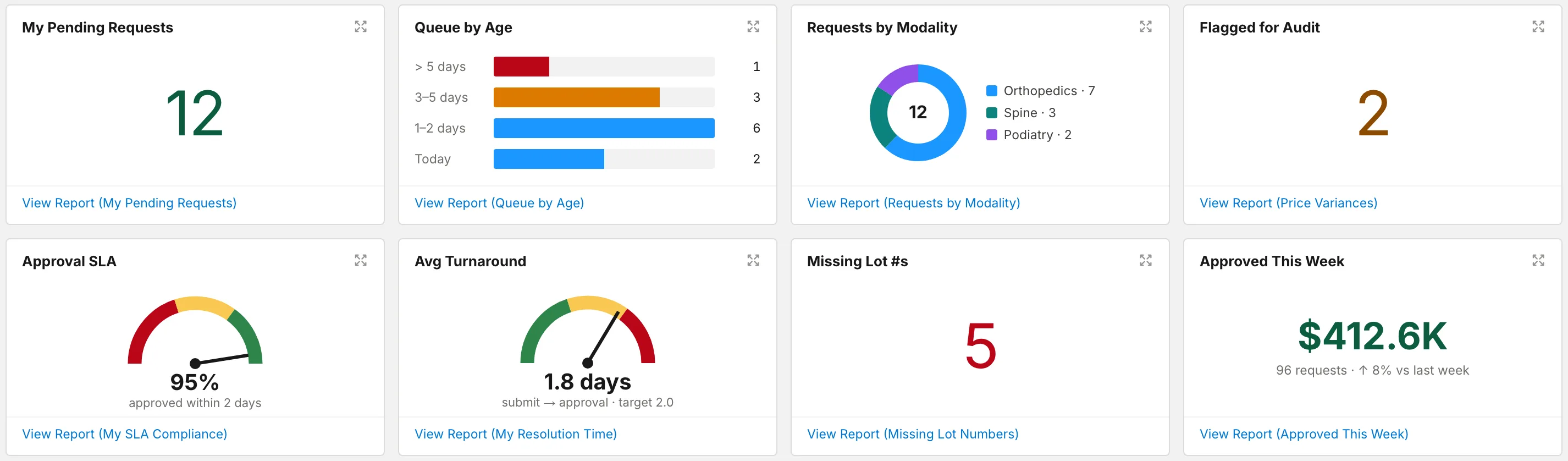
Dashboard cards: twelve pending requests, queue by age, requests by modality, two flagged for audit, share approved within target, average turnaround and value approved this week.
A bill-only request, from the rep to the purchase orderThe rep files, the system checks price and case, the approver works one line, the queue clears. Figures illustrative.

Does this happen at your hospital?

Each one is paired with the check or alert in our software that catches it, and a page that explains how.

  • The rep sends a sticker sheet days after the case

    Submission rules in Implant Control

    The rep files the request online against the real surgery, choosing lines from your contract price list. You decide when a late request needs a written reason and when it is refused outright.

    Read how a bill-only request should run

  • The price on the request is not the contract price

    Contract price on every line in Implant Control

    Contracted items are picked from your price list at your price, and anything off contract is entered separately and flagged. The approver sees the contract price beside the requested amount on every line, with any difference highlighted.

    Read how to price-check a bill-only request

  • The same implant is billed on two requests

    Case reconciliation in Implant Control

    Every request is matched to the surgical case record, and quantity one request has already claimed is not available to the next. A case number already on another open request can be flagged as a duplicate.

    Read what a reconciled implant case looks like

  • Rebates are tracked in a spreadsheet

    Contracts held as written in Rebate Recovery

    Each agreement is set up once, in a guided wizard or from a draft the contract assistant proposes from the signed PDF, and every term reads itself back in one sentence. The rebate is then recalculated from your purchase files as they load, not retyped.

    See how a rollout goes

  • A market-share rebate reads $0

    A written reason for every zero in Rebate Recovery

    Every result, zeros included, carries a sentence saying what matched and what did not. When a share is measured against a market far wider than the commitment was written about, an alert says so, because the fix is the market definition, not the buying.

    See the too-wide market alert

  • A compliance form deadline is missed

    Compliance form due alert in Rebate Recovery

    When a period ends and its form is not recorded as sent, an alert carries the rebate the form protects and grows more urgent as the forfeiture date nears. If the date passes with the form still out, it becomes a forfeiture risk alert.

    See the compliance form due alert

  • Nobody checks the tier on the supplier statement

    Earned against received, period by period in Rebate Recovery

    Each period’s rebate is calculated from your own purchases at the tier they actually reached. Record the supplier’s payment against it, and a payment made at a lower tier leaves the difference open, raised as overdue once the payment date has passed.

    Read how to check a tier determination

  • A payment is late and nobody is counting

    Payment overdue alert in Rebate Recovery

    Once a period’s payment date has passed and less has arrived than was earned, the shortfall is raised as an alert on that contract. Record the payment when it lands and the alert closes itself.

    See the payment overdue alert

Rebate Recovery alerts appear inside the product, on each contract’s page, and are not sent by email. Administrators see the portfolio alerts inbox first.

What the public numbers say

Supply costs are rising faster than anything a hospital can bill, on margins that leave no room to give contract money away.

  1. American Hospital Association, Costs of Caring, 2026

    9.9%

    Hospital spending on supplies rose 9.9% in 2025, while total hospital expenses grew 7.5%, more than twice the growth in hospital prices.

  2. Kaufman Hall, National Hospital Flash Report, May 2026

    1.7%

    The year-to-date hospital operating margin index stood at 1.7% through March 2026.

  3. World Commerce & Contracting and Deloitte, The ROI of Contracting Excellence, 2023

    8.6%

    The average organization loses 8.6% of contract value after signature. The best performers lose a little over 3%, the worst more than 20%.

  4. Association of Healthcare Internal Auditors, Maximizing Value Through Rebate Management, 2025

    $220,000

    A five-hospital system lost a $220,000 cardiology rebate outright because the one person who managed rebate compliance was on leave when the submission deadline passed.

  5. Burns et al., Medical Devices: Evidence and Research, 2018

    40 to 60%

    Physician preference items, the implants and devices surgeons select, make up an estimated 40 to 60% of a hospital’s total supply costs.

  6. GHX, Bill-Only Implant and Consignment Order Automation Guide, 2024

    10%

    Implant and consignment orders account for roughly 10% of all hospital purchase orders, and most are still handled by paper, fax and phone.

Published industry figures, each with its source beside it. They are not Techinquest results.

Written up so you can use it, whether or not you ever talk to us

How rebate money goes missing and how bill-only spend escapes contract price, from the people who build the checks.

Browse the library

See what your contracts already owe you

Bring one supplier contract and a purchase extract. In a working session we load it, run the numbers and hand you the statement: earned, received, owed.